
A few nights before school started, I sat across from my nine-year-old daughter with a color-coded chart of her fall schedule, feeling the particular pride of a parent who had planned well ahead.
The calendar was filled with extracurricular activities she had been looking forward to all summer, like a new season of gymnastics and the return of her after-school knitting club, as well as others she was less thrilled about but were important for her growth and development (yes, Hebrew School notoriously being one of them).
After just a glance at the calendar, my daughter started to cry, a visceral, big-body kind of crying. As a natural rescuer, I knew that her tears were coming from somewhere deeper. “I need a free day,” she yelled. “Mommy, I need at least one day where I don’t have anything!”
While I could see the many open hours on the calendar, I understood what she really wanted was to see a spot on the chart that was clearly marked as “FREE,” so that after a long school day or a tough week, she has the protected, dedicated time and permission to just be. To revel in the walk home from school past two playgrounds, where she greets the ice cream cart vendor, the neighborhood kids, and their nannies who all know her by name. For the impromptu playdate at our local library, where she wanders the stacks with a buddy, searching for the latest graphic novels to check out.
My daughter wanted what many of us yearn for — the unbounded, unhurried hours of the day with nothing to rush to, where we get to live fully in the present, completely lose our sense of time, and be delighted by unexpected joys because of the bliss of a blank slate.
Italians have a saying, “dolce far niente,” which means the sweetness of doing nothing. That happy, relaxed feeling you have precisely because you’re off the hamster wheel, purposefully detached from calendared obligations and social pressures. Perhaps this was the feeling my daughter was searching for?
Every fall, I use the back-to-school transition to sit down and think about what I hope for my children and how our family can grow together over the course of the school year. That day, my nine-year-old taught me a lesson that I knew deep in my heart. She reminded me that our capacities to tend to the ups and downs of life — our commitments and obligations, as well as the relationships we depend upon and nurture — thrive most in the open hours and unencumbered spaces.
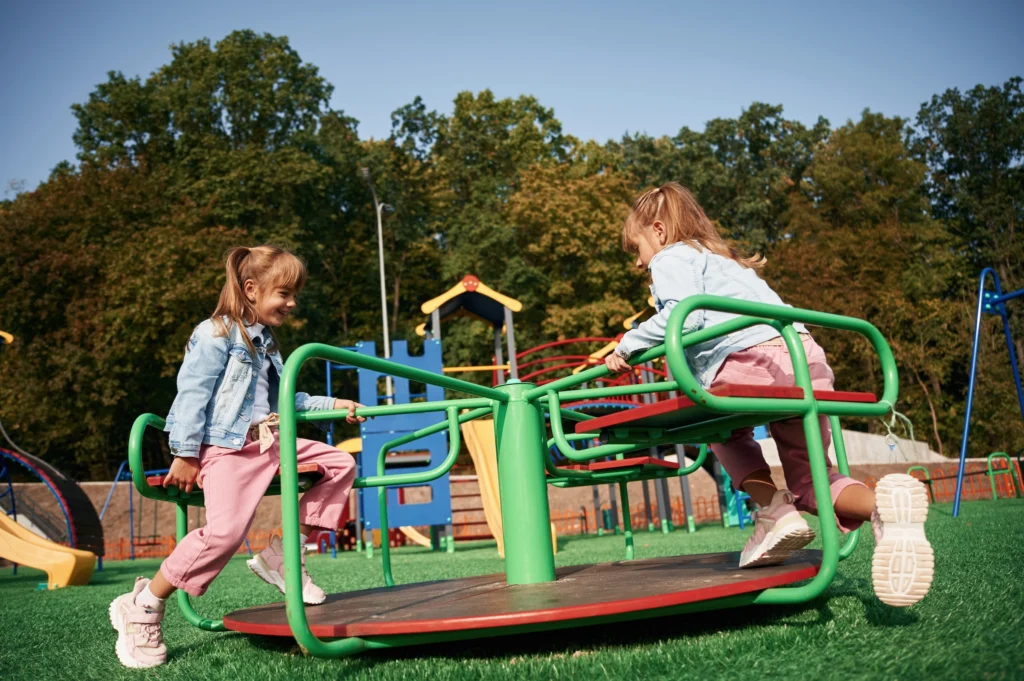
She reminded me that our capacities to tend to the ups and downs of life … thrive most in the open hours and unencumbered spaces.
Jonathan Haidt’s research on the anxious generation explains that the unsupervised and unscheduled hours children spend in a park, on a playground — or at the end of a cul-de-sac, as it was for me — do more to build a socially capable and resilient kid than we tend to give them credit for. “Children need a great deal of free play to thrive,” wrote Haidt in The Anxious Generation. “It’s an imperative that’s evident across all mammal species. The small-scale challenges and setbacks that happen during play are like an inoculation that prepares children to face much larger challenges later.”
Those unscheduled hours are where I’ve watched my daughter put into practice what she’s also learning at school: how to greet a stranger, hold another person’s gaze, ask questions from a place of interest and curiosity, navigate an interpersonal conflict, and treat others the way she wants to be treated.
Her school’s “operating system” is called S.O.S., which stands for Self, Others, and Surroundings, as a reminder that every choice we make should account for all three perspectives and the impact it may have on each one. The cultural norms of her school community put this mindset into practice every day. Every morning, students greet teachers and administrators by offering kind “good mornings” while looking them in the eyes. It is a small practice deliberately repeated until it becomes ingrained in how every person enters the school daily.
Outside of her school, this skill also comes alive when my daughter is at the grocery store checkout — the one with a cashier, never an automated self-checkout machine — because my husband had instilled in our kids years ago that we should not let convenience replace a moment of connection, even a brief one.
I don’t think it’s a coincidence that in the sliver of unstructured time my daughter has, I watch that capacity to look a stranger in the eye come alive. Bridging, the work of building trust with people who are different from us, is a muscle first named in a classroom ritual and strengthened in the ordinary minutes when a child is free enough, and unhurried enough, to notice another person and decide to say hello. The ritual names the skill. The unscheduled and unstructured hours are where she practices it.
This lesson doesn’t stop mattering once childhood ends. By the time young people reach college, the work of connection is often replaced with technical skill development and internships, with a dominant focus on career outcomes. But the same tension I saw in my daughter’s tears is playing out quietly on campuses across the country.
By the time young people reach college, the work of connection is often replaced with technical skill development and internships, with a dominant focus on career outcomes.
In an article for The Conversation, Professor Justin Vaughn observed a trend in his classroom that was echoed across other colleges and universities: Students want close connections in their lives but feel anxious about making the first move and have little practice in sustaining them.
With 6 out of 10 students reporting feeling lonely sometimes or always, efforts to promote engagement and collaboration across lines of difference also need to tend to students’ sense of belonging and their relational health.
Some campuses are noticing this connection gap and designing for it directly. At NYU, the IRL initiative encourages students, faculty, and staff to make small, conscious choices to put phones down, build meaningful interactions over activities like board games, and make the most of their time on campus. (And students are producing incredible video shorts making fun of the problem while encouraging the solution.)
At Cornell, that same instinct shows up through Cornell Unplugged and in recurring rituals such as students and faculty gathering together on Libe Slope to watch the Golden Hour sunset, spurring collective awe by experiencing the wonders of nature together. Connection opportunities like these create the container for young people to flex the social and civic muscles that they have learned in class, applying those skills and mindsets to build trust and friendships in the kind of unhurried, undirected time my daughter was looking for.
These skills and mindsets deserve the same deliberate design as any other subject a student is asked to master. I think of what happens on a playground or at a checkout line as putting into practice what they learn in school. A campus can build the container, but a greeting at a school door or a leisurely walk has often been building the muscle for years before a young adult sets foot on a college campus.
Which is what makes my daughter’s reaction to her fall schedule calendar so revealing. What she was asking for was the space to practice becoming herself — becoming a person who notices others. We nearly scheduled it away from her without meaning to.
So here is what I am carrying into this school year, with hopes it might be inspiring or encouraging to you. I believe the muscle of connection can be built at any age, mine included, if I’m willing to give myself the same unscheduled hour I’m trying to protect for her.
Before I fill a square on the calendar, I want to ask what it’s making room for and what it’s taking away. My daughter was handing me a lesson about my own days: the meetings stacked back-to-back, the walk to the office I take at a clip instead of a stroll, the days that end before I noticed a single stranger’s face. If I want her to keep noticing and greeting and looking people in the eye, I have to keep practicing it myself, grown as I am, same as she’s practicing it at nine.
With my daughter’s lesson in mind, I hope more of us recognize that social connection is foundational to everything else, and we need to ensure our lives are structured in ways that set us up for success. And for us type-A parents, success here is not a result of overprogramming, but rather letting our kids roam a bit more freely.
I hope your fall calendar is dotted with unhurried moments that spark connection. Who might you notice, and who might you greet, if you give yourself the hour to look around?