
I asked ChatGPT what I might say to a room full of AI experts about the importance of social connection in preparation for short remarks at a recent gathering held by our partner Noēsis Collaborative focused on AI and human flourishing. I was told “the message lands best if it meets them on their own terrain – systems, intelligence, scaling – while gently insisting on something technology still can’t replace.”
Good advice, I thought. On the one hand, as someone advancing the science and practice of social connection and social cohesion, I could offer a reminder of the uniqueness and necessity of relationships. On the other hand, as AI gets better by the day at performing empathy, curiosity, and emotional support, those of us in the work of social connection need to sharpen our case.
There is heightened focus on how to build AI systems that mitigate the harms to connection and enhance relationships.
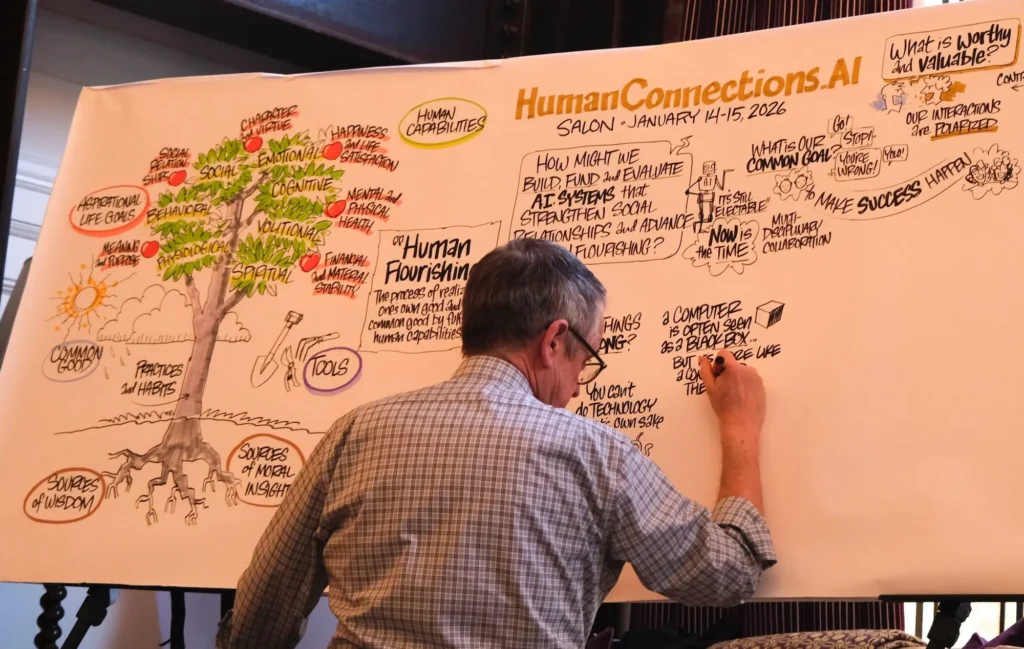
Many of us come to this endeavor from a shared sense of why this work matters. We see the stakes, the risks in not doing so, and the fleeting window of opportunity. This sense of urgency animated the gathering and motivates Einhorn Collaborative’s work to mitigate the negative effects of social AI.
Another part of the why is a belief in the unique value of real connection. I suspect that’s a belief formed more through the richness of our own relationships than through any research that confirms what we know in our bones: that connection imbues our lives with meaning and helps hold families, communities, and societies together. Even still, tech companies are coming for our relationships. In the gap between our faith in human connection and our struggles to find and foster it, Silicon Valley sees a market opportunity.
In a recent podcast interview, Bob Sternfels, the global managing partner of McKinsey, talked about how AI is reshaping the consulting firm’s workforce. He explained how AI agents can handle entire functions on their own that used to be done by employees. Yet the firm is still adding client-facing roles as AI enables people to “move up the stack” to focus on more complicated problems. He added that young professionals coming into the workforce should hone skills that AI cannot do: setting the right aspirations, exercising human judgment, and expressing true creativity.

With social AI designed to be humanlike, and the market for these products predicted to grow rapidly, Sternfels’ assertion invites another angle on this question: what are the relational skills and experiences that AI cannot fully perform? Put another way, why do we still need each other when it comes to social connection?
Reflecting on Einhorn Collaborative’s work, from early relational health to civic health, bonding to bridging relationships, I want to highlight two aspects of connection that remain the purview of people and not machines: repair and reciprocity.
With the rise of sycophantic AI, we talk about how real human relationships are messy and full of friction. Let’s extend that further. Relationships also go awry. In our intimate bonds, our friendships, and our communal ties, connection is punctuated by disconnection. Conflicts arise.
And yet, in the face of rupture not all relationships unravel for good, and repair is possible. The most transformational work I have seen in the pluralism space equips people with the skills to name differences, work through toxic conflict, forgive, rebuild trust, and forge a shared path. But repair requires more than skill; it requires real stakes — having something to lose, looking inward, being open to being changed. People can be vulnerable and show up in this way. My hunch is that AI cannot. Repair requires humans on both ends.
Not only is repair impossible in an AI relationship; new research suggests that the validation-focused coaching that chatbots provide make people less willing to repair interpersonal conflict in real life. If AI convinces me that I’m right, why bother with the painful work of mending? Why take a hard look at myself in the mirror?
It is easy to see how discomfort with repair or even friction can compromise our close-in relationships. It also complicates the work of building a shared society. “Democracy works best,” writes Sherry Turkle, “if you can talk across differences. It works best if you slow down to hear someone else’s point of view. We need these skills to reclaim our communities and common purpose. In today’s political climate, we need political skills that generative AI may erode.”
What also gets obscured is that AI asks nothing of us in return. There is no actual reciprocity. As Adam Grant puts it, “In healthy relationships, we give as much as we receive. In AI exchanges, we can receive endless streams of information and affirmation, but we have nothing to give back. No matter how good large language models become at simulating care, they’ll never substitute for real relationships, because they have no needs to care for.”


Repair requires more than skill; it requires real stakes — having something to lose, looking inward, being open to being changed. People can be vulnerable and show up in this way. My hunch is that AI cannot. Repair requires humans on both ends.
A throughline in our work at Einhorn Collaborative — whether fostering emotional connection between parents and babies, helping young people strengthen belonging in their communities, or building bridges across deep divides — is that reciprocity is at the heart of social connection. Relationships are deepened when there is mutual recognition, when a person meets our needs and they depend on us to meet theirs, when we sit with a loved one and embody empathy in ways that words can’t express. AI might help us practice these skills and even feel less lonely, but the contribution and the value flow in just one direction.
We should mitigate the perils of AI that might degrade our relational skills and tap the potential of AI to enhance those skills. If we want people to experience connection in its fullest sense, we must steer AI in a more prosocial direction and create the conditions, norms, and opportunities for people to have trusting relationships with other humans. Ideally that makes synthetic ones less needed, playing a supporting role but not standing in for the real thing. That is why progress in building AI that boosts rather than saps our relational lives is intertwined with progress in fostering face-to-face connection.
If we insist that AI can’t replace the real thing, we must also contend with what gets in the way – with how the transcendent power of connection collides with the ground truth of disconnection. The new Social Connection in America report finds that 72% of people feel a sense of belonging in their local communities and neighborhoods, yet that same percentage get together with people they care about just twice a month or fewer. And disconnection is experienced more by those with less education and lower income, as well as people who are Asian, Black, Hispanic, or multiracial. The Connection Opportunity report reveals that nearly three quarters of Americans want to connect across difference in their communities, yet the most common barrier they cite is a lack of opportunity. Complicating matters is the allure and ease of aloneness. As Derek Thompson points out, “self-imposed solitude might just be the most important social fact of the 21st century in America,” aided by our “home-based, phone-based” existence.
So as AI joins the set of forces disrupting our relational lives, it is not just a call to connection we need. It is also investment in solutions that enable and inspire more people to heed the call. Despite the headwinds, there is growing momentum in this work, propelled by both national action and local agency.
Meanwhile, as we channel the emerging research on the effects of AI on social connection, we ought to resist the urge to judge others and ourselves for trying these products. Amidst the upheaval, despair, and fear so many are experiencing, maybe engaging with an agreeable AI companion is not so much a retreat from reality as a yearning for a kinder world.