
I have a confession to make. While I’ve spent nearly two decades working on issues related to bridging divides and addressing the crisis of connection, I’ve come to realize I still have a lot to learn when it comes to engaging in conflict.
What’s difficult about this confession is, in this era of hyper-polarization where we are navigating the extremes between high conflict and conflict avoidance, I’ve felt relatively proud of my comfort engaging in difficult conversations with relative ease.
I say relative because engaging conflict is hard for even the most seasoned among us. Over the years, I’ve developed the muscles needed to lean in when others pull back, hold space for multiple truths to exist, and find areas of common ground that move people into shared action.
Since I’m in confession mode, I’ll admit this ease shows up much more readily in professional contexts, less so in personal ones. At the end of a long workday, I often find myself conflict-fatigued, seemingly unprepared to navigate arguments about what’s for dinner, homework completion, or kid-centric calendar logistics.
The version of me that can stay present, calm, and even excited to engage in conflict well at work quickly gets replaced by someone who snaps into defensiveness or goes completely mute, fully disengaging, often because I’m feeling misunderstood, exhausted, or most typically, both.
The disconnect between my work and home life gnawed at me. And again, if I’m fully honest, some recent disagreements in my work life made me think “that could have gone better.” So, I decided to sign up for a refresher course with Resetting the Table, one of our grantee partners, to brush up on the skills I thought I knew well but certainly could get better at.
I came into the two-day workshop with the goals of understanding my blind spots, noticing my well-worn behaviors, and becoming a better communicator, so conflict-fluent Jenn could get an operating system upgrade.
At the start of the training, our coaches, Eyal Rabinovitch and Leah Reiser, walked our group through what happens to our brain and body during charged interactions that trigger our fight, flight, freeze, or fawn responses.
In conflict, people become adversaries and one-dimensional in our mind, making it harder to want to hear their side of the story or have empathy for their values and beliefs.
So often, we seek evidence that proves us right, while ignoring everything that does not fit our narrative. Our brain focuses on how we have been harmed and who is to blame, forgetting that the people on the other side of the divide want to be heard, seen, and understood just like we hope to be.
“Empathy stands as a firewall against bigotry,” wrote David French in his New York Times column. “But it’s more than that — it can also free you from bigotry. Understanding another person’s experience (and imagining if it happened to you) softens our hearts and creates human connection.”
So, what do we do? And where do we go from here?
Resetting the Table began our training with three fundamental tools to disrupt these destructive patterns and communicate more effectively across our divides: Following Meaning, Demonstrating Understanding, and Naming Differences.
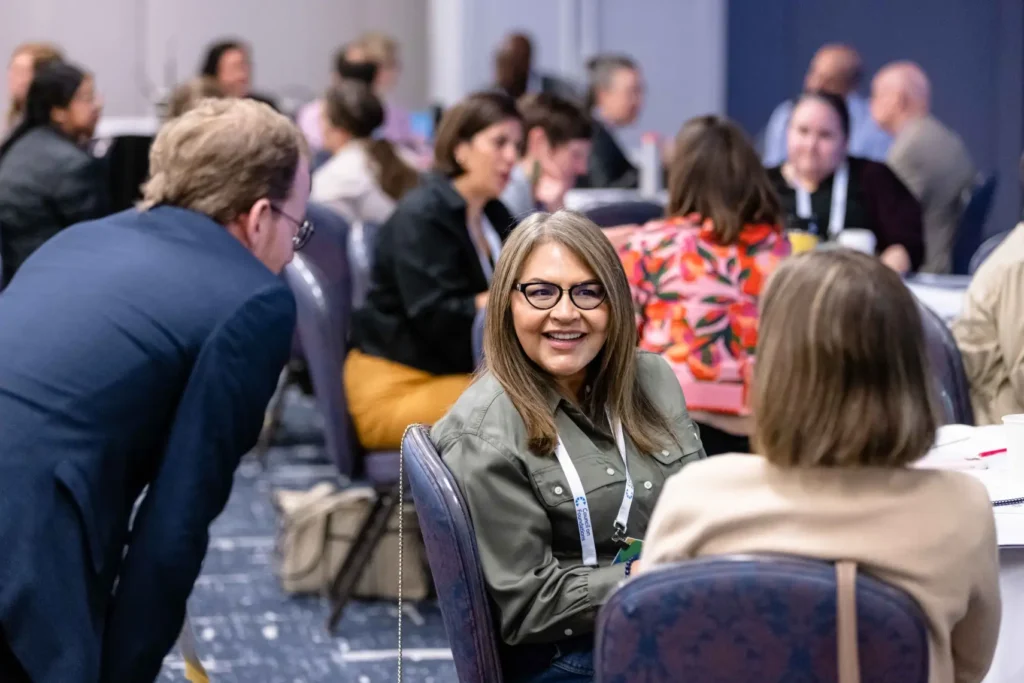
After watching Eyal and Leah demonstrate the skills, our task was to listen carefully to each other’s stories and identify cues that told us what is most meaningful to the speaker.
The key here is to follow “signposts of meaning” with clarifying questions that draw out what matters most – importantly, not to satisfy our own curiosity but rather to understand the person more fully. Often these questions unlock greater clarity of what is most important to the speaker.
The second step is to reflect someone’s story back to them so accurately that they feel seen and understood for exactly who they are and what matters most to them. When I practiced this method with a fellow participant, I could feel the difference in energy when my conversation partner said, “That’s almost it, but…” to when the walls came down, shoulders dropped, and I got: “That’s exactly it. You got it.” Bullseye.
The third step, for me, is the hardest and the most consequential: naming the difference. As a common-ground type of person who loves problem solving, it’s clear I’ve engaged in many a conflict without fully naming (or even understanding!) the fundamental difference at hand. I’ve become a big believer in and advocate of the power of identifying what we have in common. I have always thought that if we could better see our commonalities, we could better empathize with and appreciate those on the other side. What I learned in this training is that common ground only gets you so far. It’s not bad, it’s just incomplete.
Without being able to name the difference absent judgment, bias, or preference, we cannot fully see what the conflict is all about. And if we don’t know what the conflict is about, we can’t get to the other side of it. Operating from a place of ambiguity makes it that much harder to collaborate with one another and come up with creative and enduring solutions that meet the needs of people on both sides of the divide.
Naming the difference sounds something like: “The difference here is about urgency. Person A thinks change needs to happen immediately. Person B thinks change can happen over time.” Of course, there’s so much more to both Person A’s and Person B’s story and what matters most for each of them. By naming what the difference is about, both can better understand the other and what is fundamentally getting in their way.
When put together, these three skills help us tackle our conflicts with boldness, clarity, and empathy. Instead of minimizing a disagreement out of politeness or watering it down to commonalities to reduce discomfort, by specifying where the conflict lies, where each of us stands, and what matters most, we can move forward together.
I know these techniques may sound easy, but you’d be surprised knowing the number of rounds it took for each person in our group to get to a “bullseye” reflection and be ready to confidently name the difference. For me, I noticed how often my desire to fix a problem and get to a resolution prevented me from truly listening and understanding the conflict at hand. I realize now how many conversations in my life, especially with the people I love most, would have benefited from such clarity.
While I need to strengthen my “naming differences” muscle — and through this three-month facilitator training, I’m sure this is the spot my coach and I will focus on — I’m even more convinced this approach is essential to transform the conflicts, both big and small, across every facet of our lives.
Often, when I tell people about our work at Einhorn Collaborative, many assume we are only in the finding common ground business and that our work papers over the most difficult disagreements and entrenched conflicts. But that’s far from what we’re after. We know that a socially connected and cohesive society does not require less conflict. What we need is better, more productive conflict.
The truth is, we need the full suite of skills if we are to break out of this highly contentious, high-conflict society. Sometimes, what we need to reach for is our shared humanity, identifying places where there is common ground. Sometimes, we need conflict transformation and constructive dialogue — the slow work of listening deeply and speaking bravely to reach shared understanding. And sometimes, what we need is healing, where we acknowledge the harm that has occurred and work together to repair when possible.
In our generational work of fostering human connection and bridging divides, I feel an immense sense of gratitude that we sit among a constellation of partners like Resetting the Table who are constantly refining and innovating on toolkits and approaches to make it easier for all of us to hear and understand each other better.
Next time you are faced with a clash of perspective — whether it is with your child, neighbor, colleague, coalition partner, or an “other” across a perceived divide — consider reaching into your conflict transformation toolkit. Ask the other person questions that would give you a deeper view into who they are and what matters most. Take the time to reflect back to them what you’ve heard and ask them if you got it right. Then capture where your disagreement lies. Do all of this before coming up with how you’d like to move forward. And even if the issue remains unresolved, I hope you experience the gift of what it feels like to understand someone so deeply that they feel seen, dignified, and loved by you. When they say “exactly,” your heart will swell.