What is one of your earliest memories of the power of human connection?
I grew up in the Midwest in Wichita, Kansas. On April 26, 1991, a devastating tornado hit my hometown and the neighboring towns, destroying small communities and claiming the lives of several people living in a trailer park in Andover.
At that time, Kansas was going through real division and violence, especially surrounding the issue of abortion. But in the tornado’s aftermath, people weren’t Republicans or Democrats — they weren’t divided at all.
My parents took me to Andover because we had family there. I remember seeing buildings destroyed, people’s lives strewn about the streets, and people passing out water and food on that busy, hot spring day. We went to a local church, got food and water, and gave it out to those who needed it. I remember one really striking image of a person I didn’t know walking into a devastated, ruined house to pick up a teddy bear and give it to a child who lived there.
I come back to that moment often. Underneath the veneer of division, human beings are collaborative beings. We cry out for connection; we want to be there for other people, and we want other people to be there for us.
What values guide your personal life and your work?
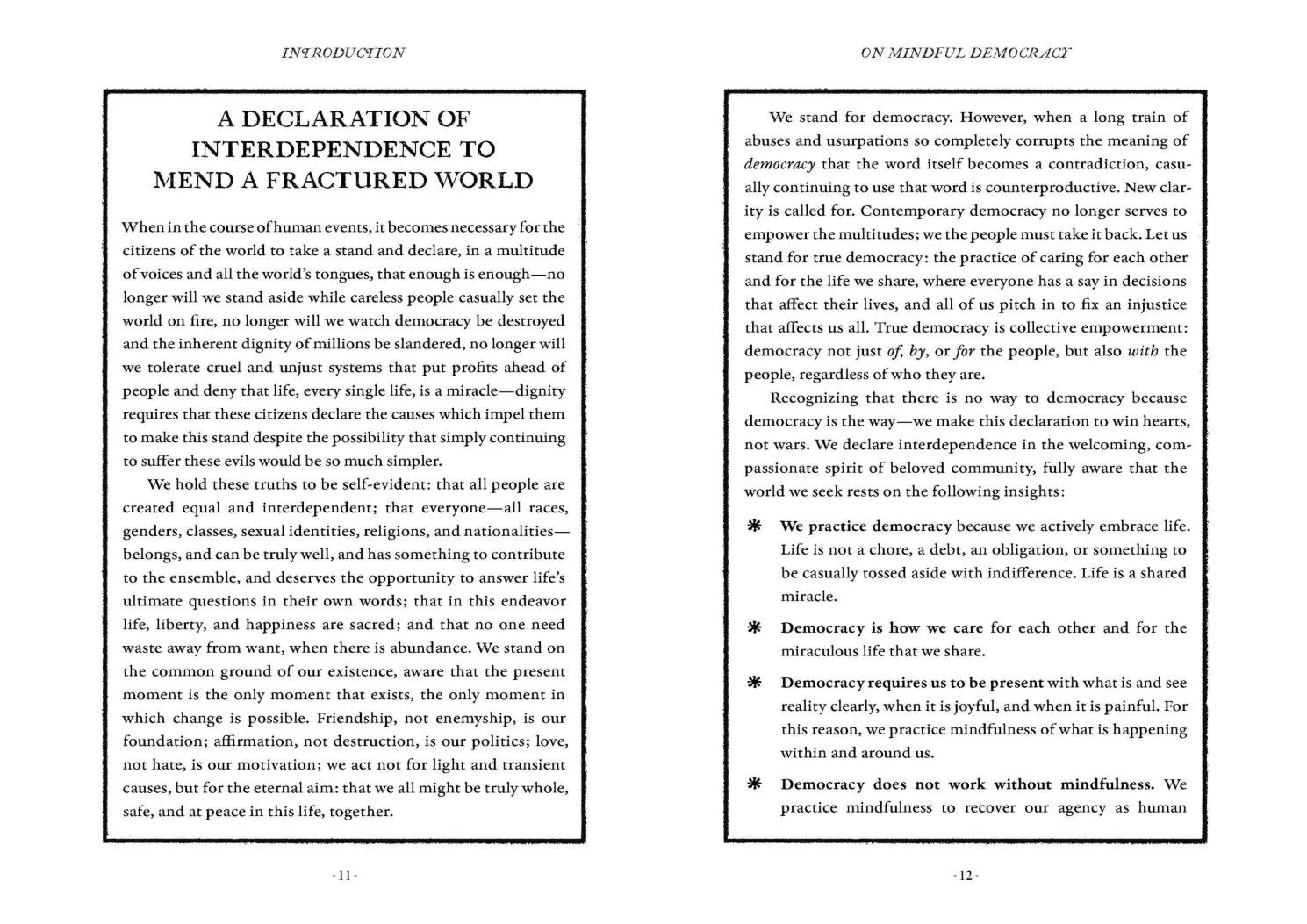
In the book, On Mindful Democracy, I rewrote the Declaration of Independence as a Declaration of Interdependence. The second paragraph is probably the closest thing I’ve ever written to my own heart, expressing the values that are at the core of my being and that guide my life.
We hold these truths to be self-evident, that all people are created equal and interdependent, that everyone — all races, genders, classes, sexual identities, religions, and nationalities — belongs and can be truly well and has something to contribute to the ensemble and deserves the opportunity to answer life’s ultimate questions in their own words, that in this endeavor life, liberty, and happiness are sacred, and that no one need waste away from want when there is abundance. We stand on the common ground of our existence, aware that the present moment is the only moment that exists, the only moment in which change is possible. Friendship, not enemyship, is our foundation. Affirmation, not destruction, is our politics. Love, not hate, is our motivation. We act not for light and transient causes, but for the eternal aim that we might be truly whole, safe, and at peace in this life together.
I believe people are equal and interdependent. I believe everyone belongs, deserves dignity and respect, and has something to contribute to our shared life. I believe in common ground, and I believe it’s always there. As activists and educators, we have a duty to see common ground, find it, and speak from it. When we stand up, we stand on this common ground.
I believe in friendship rather than enemyship, in affirmation rather than destruction, in love rather than hate. And I believe that we have a duty to each other to try to create a world where we can all be truly whole, safe, and at peace together.
When did a person or experience change your mind about an idea or belief?
I love this question, because one of my insights in the book is: “Changing your mind is not weakness, it is the work of a brave soul.” I’ve found that my college students are often reluctant to speak up because they have a deep anxiety of being wrong.
A recent example: the first big event I did for On Mindful Democracy was at Webster’s, our local independent used bookstore and cafe. It’s my favorite place in this town, other than the yoga studio that I run. The owner of Webster’s, Elaine, is someone who truly brings people together and makes good things happen.
In her opening remarks, Elaine said, “I love this book — but there’s one thing I really don’t like.” She was referring to a perforation on the page of the Declaration of Interdependence, which I designed to look like the original Declaration of Independence. I thought that people might want to sign it, tear it out, and read it aloud to others.
Elaine, as a bookseller, pushed back hard: “Please don’t tear pages out of the book.” She said books are meant to be circulated and shared, and tearing pages out deprives others of some of the knowledge of that book. Taking the stage after Elaine, I told the room, “Elaine is right, and I wish I hadn’t done this.”
My wife Anna came up with the solution: print standalone copies of the Declaration of Interdependence to hand out at events, so people can take it with them without damaging the book. Parallax Press is now printing a version for exactly that purpose. Elaine identified the problem; we found the answer together.
I felt everything one feels when realizing they’re wrong, but that became an opportunity for growth. If we face those moments with bravery, they really can open the door to new ideas.
What are you working on right now?
I’m continuing to promote On Mindful Democracy and doing events around the country. I’ve started hosting communal readings of the Declaration of Interdependence, where people gather and take turns reading lines from the text. It’s a powerful moment of community building.
I’ve also begun developing a new vision of civic education grounded in mindful democracy. I’m working toward an eight-week training course in mindful democracy, and I hope over the next few years to help start a center for mindful democracy — bringing together educators, civic leaders, and citizens to reimagine how we teach people to be citizens and how mindfulness can be a core civic skill.
I think we stand on the cusp of a renaissance in civic education. This is a moment that calls for something revolutionary — in the spirit of how the Declaration of Independence was revolutionary — to gather people together to chart a new course. I’m excited to see what collaborations emerge.
What is giving you hope or what positive visions do you have for our future?
When I teach, I try to encourage people to see situations in their totality — not just what’s wrong, but what’s right, and what conditions exist that would allow us to work together to transform suffering into joy.
Going back to that tornado in Andover, the thing that gives me hope is other people. I see so many individuals — students, activists, parents, teachers, neighbors — who are hungry for connection and healing. They want a more compassionate world.
When we slow down, when we breathe, when we truly see each other and are present with each other, hope becomes something we can practice together. Hope is not just something we wait for, but something we do.
More Through the Prism Interviews