There is a particular kind of boundless potential that lives on a college campus.
It’s found when two roommates meet for the first time and stay up late into the night talking about their hobbies, hopes, and dreams for the year ahead. It shows up during class discussions that take students by surprise — exposing them to people, ideas, and beliefs that they have yet to encounter. It grows in moments where young people find their sense of purpose, realizing that their voices matter and that, by working with others, they can make positive changes in our society.
I can still recall the feelings of excitement and adventure — filled with a hopeful, youthful idealism — during the early days of my undergraduate experience. I also remember feelings of anticipation and wonder: Would I find my people? Would I find my way? Where will this road take me? Luckily, I was surrounded by peers who were asking themselves the same questions, eager to make meaning and make the most of this short time on campus.
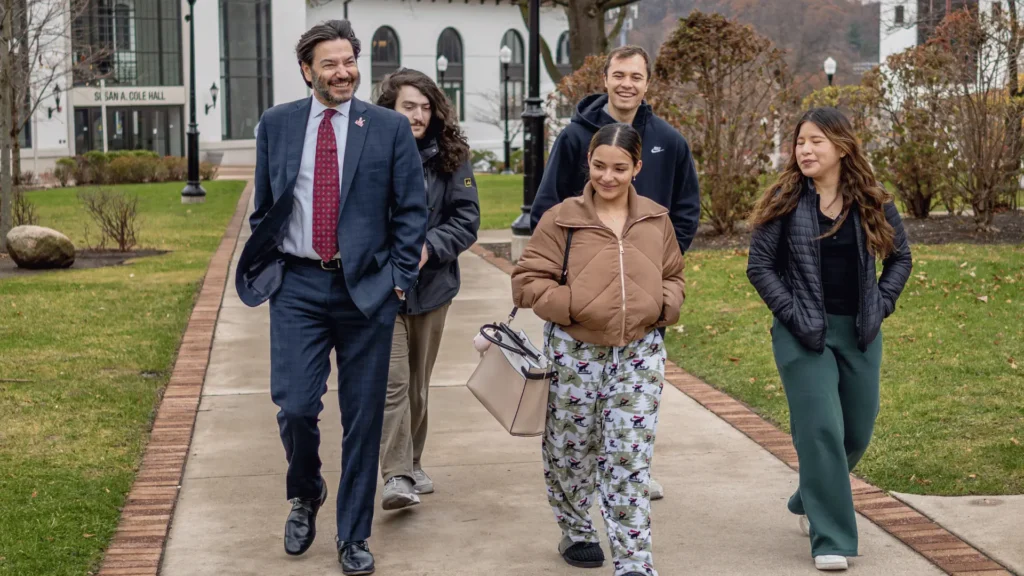
Those four years were transformative. They led me to life-long friendships with people whom I can still call at 2 in the morning, to campus gatherings that eased the feeling of homesickness, and to community-engaged learning courses that showed me a different side of life and how I can be of service to others.
College also provided me with the time and space to practice new skills, take risks, try on new ideas for size, and make mistakes (oh, so many mistakes) in a supportive environment, held together by the encouragement and grace offered to me by my professors and fellow students.
Yet, that world of infinite possibility feels like it’s disappearing when I reflect on my college experience with the stories about higher education in the media today.
Campuses across the country are confronting a convergence of pressures: concerns over freedom of expression and ideological diversity, rising costs, declining enrollment, a turbulent job market for new graduates, and economic uncertainty around AI.
While the challenge before us is complex, I still believe that higher education is one of the most powerful levers we have to equip young people with bridging skills and motivations to become engaged citizens and effective leaders of tomorrow.
According to a More in Common study conducted with the Constructive Dialogue Institute (CDI), almost half of college students are afraid to share their opinions in the classroom for fear of offending their peers. One college administrator recently shared with me another troubling trend: when roommates get into serious disagreements, instead of addressing the issue directly, they call campus police to intervene.
The repercussions of self-censorship, conformity, and retreat from difficult conversations do not end in the dorm room or classroom. Without opportunities to regularly practice and develop the skills and mindsets needed to build authentic relationships and engage in healthy conflict, especially across lines of difference — young people are underprepared to seek out divergent perspectives, foster empathy, build trust, and collaborate well with others when they enter the workplace, participate in their communities, and take on civic responsibilities.
While the challenge before us is complex, I still believe that higher education is one of the most powerful levers we have to equip young people with bridging skills and motivations to become engaged citizens and effective leaders of tomorrow.
That’s why I am very excited to share our newest partnership with the Institute for Citizens & Scholars (C&S) to accelerate the reach and impact of their College Presidents for Civic Preparedness coalition. Over the next five years, this first-of-its-kind, national effort will reach 4.5 million students across 400 institutions of higher education — spanning two- and four-year universities, public and private colleges, and Historically Black Colleges and Universities and Minority-Serving Institutions — providing students with myriad opportunities to engage in constructive dialogue and collaborative problem-solving before they graduate.
Importantly, the aspiration to repair campus culture is not only coming from the top of universities; students also want to practice and develop these skills, motivation, and mindsets.
“While the media uplifts the loudest voices from the most temperamentally extreme perspectives, the majority of young people are seeking constructive dialogue. Students are delivering a unifying and resounding message about political violence: This has to stop,” wrote Manu Meel, CEO of BridgeUSA, the nation’s largest youth-led bridging organization on college campuses, following the assassination of Charlie Kirk. “[Their voices are] not a naive call for bipartisanship but a hardened recognition that their physical safety might very well depend on America’s college campuses embracing a culture of pluralism.”
These commitments especially matter now, when technology is reshaping who we are, how we relate to one another, and our ability to communicate and solve real problems together.
Human skills — the ability to sit across from someone different from you, to listen with genuine curiosity, to disagree without contempt — are no longer supplemental to a good education; they are foundational to a good education. These are also the skills that our fractured society demands at this moment.
As a parent and as someone who has worked in the bridge-building space for nearly two decades, I know that the most meaningful opportunities to practice and develop these muscles don’t happen by accident. They happen by design — when institutions create the conditions, programming, and culture that make authentic connection across lines of difference possible.
C&S is hard at work with college presidents and in partnership with leading pluralism organizations in higher education, like Interfaith America and BridgeUSA, to shift how institutions think about their civic duties and responsibilities to students, and to our social fabric as a nation. And there is room in this coalition for more — more presidents, more campuses, more funders — to provide more students with the opportunity to live into the boundless potential of their college years and prepare them to become empathetic citizens and future leaders.
Somewhere on a campus we haven’t yet reached, there is a student who doesn’t know how to bridge the divide between her world and her roommate’s. There is a first-year student who has never had a real conversation with someone who votes differently, prays differently, or grew up in a different kind of America. A young person beginning to wonder whether the idea that we can solve problems together is even worth believing in.
This partnership is for them. It is a bet that, with the right support structures and leadership, college campuses across the country can become the place where these young people become bridgers.