
I read On Mindful Democracy by Jeremy David Engels, cover to cover with pen in hand, over a long afternoon.
My dear friend, Rabbi Josh Feigelson, recommended it, and Josh has never steered me wrong. Nearly every page, I found myself underlining something and nodding along.
When I finally had the chance to sit across from Jeremy just a few weeks ago, it immediately felt like we were kindred spirits.
Jeremy structures the book around 27 insights for what he calls a Declaration of Interdependence — a reimagining of America’s foundational promise for the next chapter of our lives together. The insights range from the sweeping to the startlingly simple:
Democracy is how we care for each other.
Gratitude is the foundational democratic emotion.
The true power of words is mending.
Hate has no place in democracy.
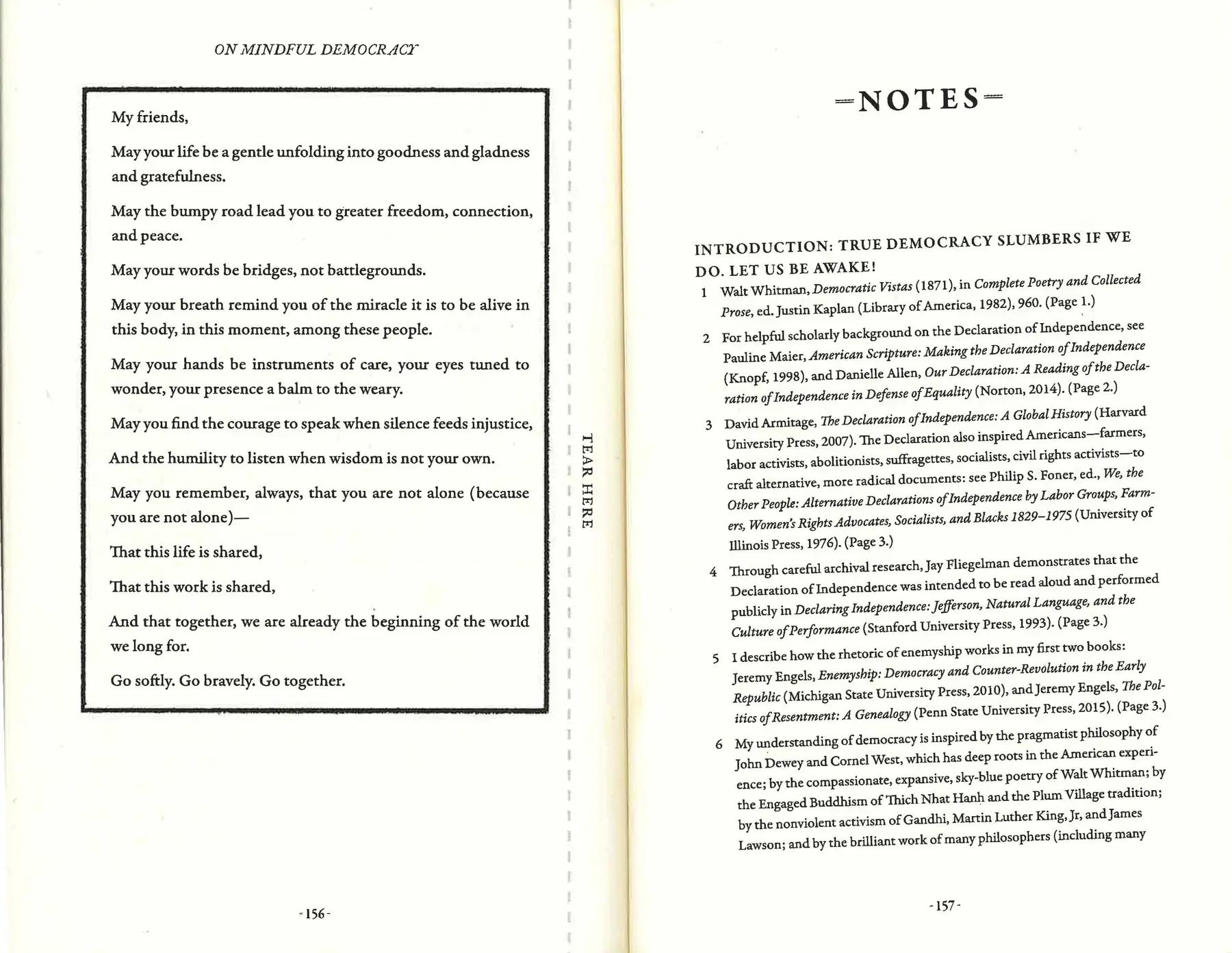
The book is neither a policy manual nor a tactical guide, but rather a mindset and prayer that envelops readers in hope. By the time I reached the final meditation, I’d already retrieved the tape from my desk drawer. Those words are now on my wall — a mantra I return to when I need to remember who we are and who we are still becoming. (A quick note: in our Through the Prism interview, Jeremy shared his regrets for encouraging people to tear away the page from the book and his wife’s solution for future readers!)
Democracy, Jeremy reminds us, is not something that happens to us in election years. It is something we do every single day through our simplest interactions: acts of love, of connection, of compassionate listening. It is the belief that we can build something more beautiful together because of our differences, not despite them.
As we stand at the threshold of America’s 250th birthday, I find that belief both more urgent and more fragile.
Peacebuilder and author John Paul Lederach offers a useful frame for why this anniversary feels particularly different to me. In a conversation with Krista Tippett and America Ferrera, Lederach asked listeners to do an exercise he had learned from his mentor, Elise Boulding, called the “200-year present.”
In the exercise, you identify the oldest person who ever held you as a child and calculate back to their birth year. That would be my Great Grandfather, Sam, who was born in 1898. Then you imagine the youngest member of your family and trace the full arc of their life forward. That would be my daughter, who will (God-willing) celebrate her 100th birthday.
That span of time — over 219 years, from 1898 to 2117, stretching from the Spanish-American War to a future I will never see — is my lived, embodied relationship to history.
In the centuries that wrap around us, Lederach wrote of the long arc:
it’s a long journey
to reach the far horizon and
hold fast to love
John Paul Lederach
When I hold that imagery in mind, with the birth of my grandfather at one end and imagining the smile lines and grey hairs on my daughter at another, the 250th anniversary of America stops feeling like a vast number. As my own wingspan stretches across this relatively young country’s story, 250 years start to feel like both a gift and an enormous responsibility.
That impulse is at the heart of Einhorn Collaborative’s partnership with faith250 — an initiative that invites faith leaders and congregations across the country to gather, listen, share civic values, and celebrate shared hopes for America. Together as a community, participants study some of our country’s most sacred texts, such as The Declaration of Independence and Emma Lazarus’s “The New Colossus” inscribed on the pedestal of the Statue of Liberty, as well as “America the Beautiful,” and Frederick Douglass’s address, “What to the Slave is the Fourth of July?”
These texts carry America’s “250-year present” precisely because they hold the country’s promises and its shortcomings in the same hands. faith250 creates the space for people from different religious and spiritual traditions, as well as those who are religiously unaffiliated, to come together and explore that tension and ground themselves in the most important questions of meaning and belonging: How do we love our neighbors? What does citizenship require of us? How do we build a community worth belonging to?
Research from our partners at More in Common U.S. reinforces how much spaces like faith250 matter. Sixty-six percent of Americans believe they can learn a great deal from connecting with people who are different from them, and 70% feel a personal responsibility to do so. Nearly half say they want their religious leaders to offer spiritual guidance on navigating polarization and talking across political lines. And Gen Z, so often assumed to be drifting from faith, is only nine percentage points behind Baby Boomers in saying their connection to the sacred matters to them. They are, in fact, more likely than the average American to turn to faith for belonging and community.
Even in times when we are told we are hopelessly divided, we continue to reach for one another.
Moreover, the ability to see our shared humanity begins far earlier and can be nurtured in unexpected places.
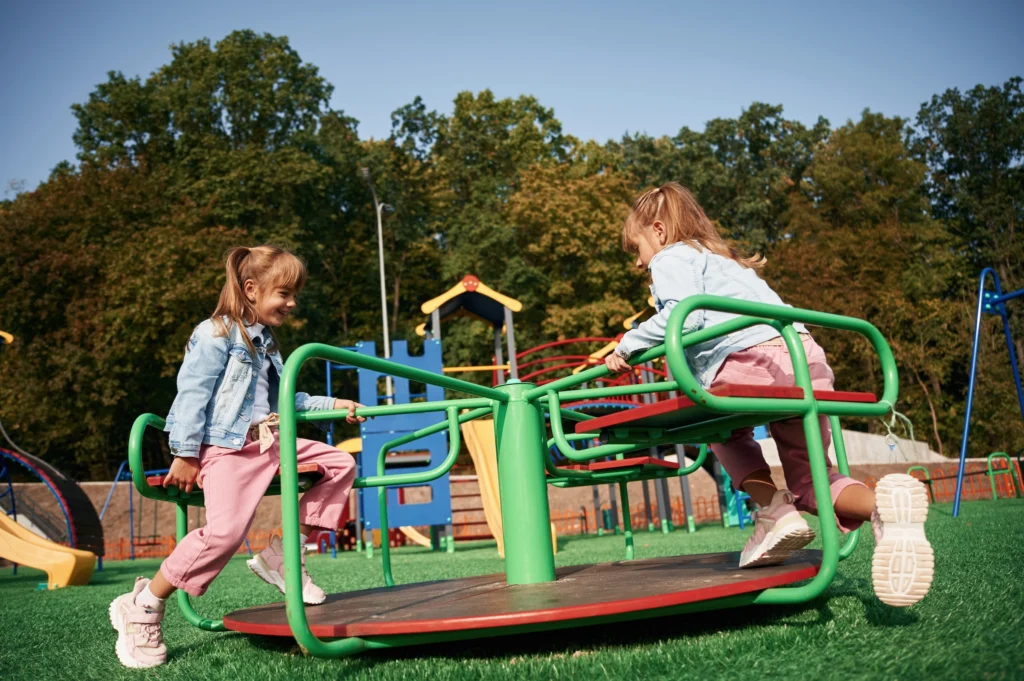
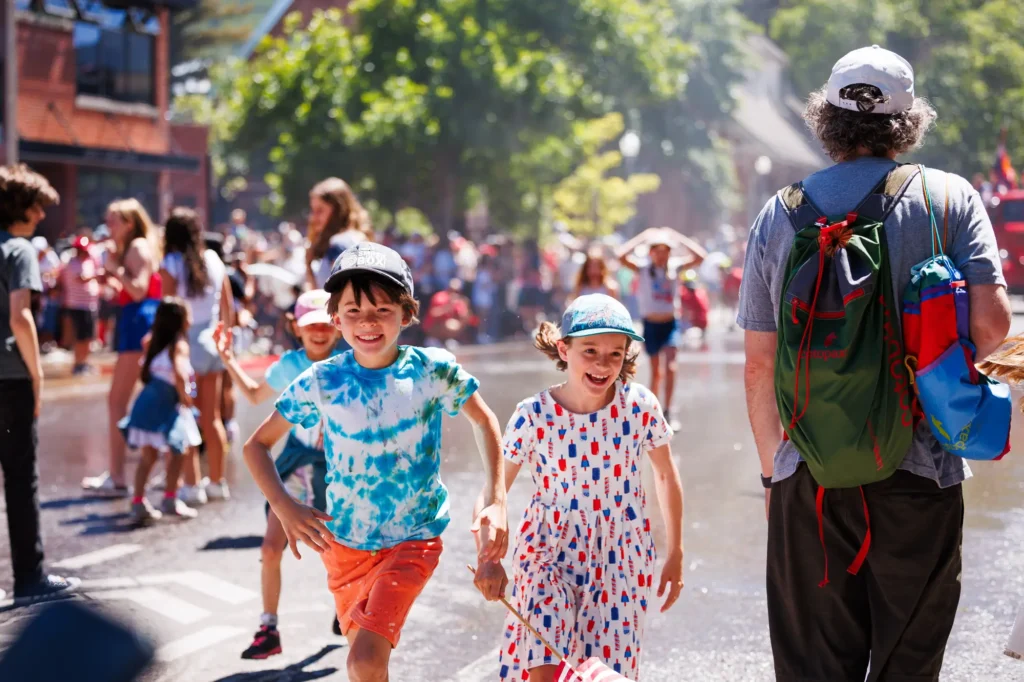
That’s why, alongside faith250, we partnered with GBH Kids to help produce a new children’s television show for PBS called America’s Awesome Kids, a program designed to help children and parents build connection, empathy, and understanding, both within their households and with people across the country.
When I watched it with my daughter, she understood it immediately. She didn’t need to be told what it was for. She saw kids both like her and different from her, finding joy in the seemingly mundane, ordinary, irreplaceable texture of childhood. She could recognize herself in the kids doing cartwheels in their backyard, even though their topography looks radically different from her life in New York City.
Whether it is through watching peers on PBS or attending a multifaith gathering, the underlying impulse is similar: we reach for one another.
Jeremy closes his Declaration of Interdependence with these words: “Our independence has always been interdependence. Let us embrace it, declare it, and live by it, for the benefit of all beings.”
This is the patriotism I want to carry into this 250th anniversary of America’s founding. The kind that takes the fractures seriously and chooses daily to show up for one another.
Somewhere across the country, there is a congregation about to read Frederick Douglass’s words aloud together for the first time and discover, in the room, someone whose family lived those words. Somewhere, there is a child watching a peer talk about their love of bugs on PBS and thinking, “I didn’t know anyone else loved bugs as much as I do.”
These moments are our 250-year present, and I’m grateful that I get to live through this period of history with you.